
Table of Contents
If you run an estate or letting agency in the UK, the way prospective sellers and landlords find you has changed more in the last two years than it did in the previous ten. Google’s search results look different. AI tools like ChatGPT and Google’s AI Overviews are answering questions before anyone clicks. And the property portals you’ve spent years paying for are no longer the only game in town.
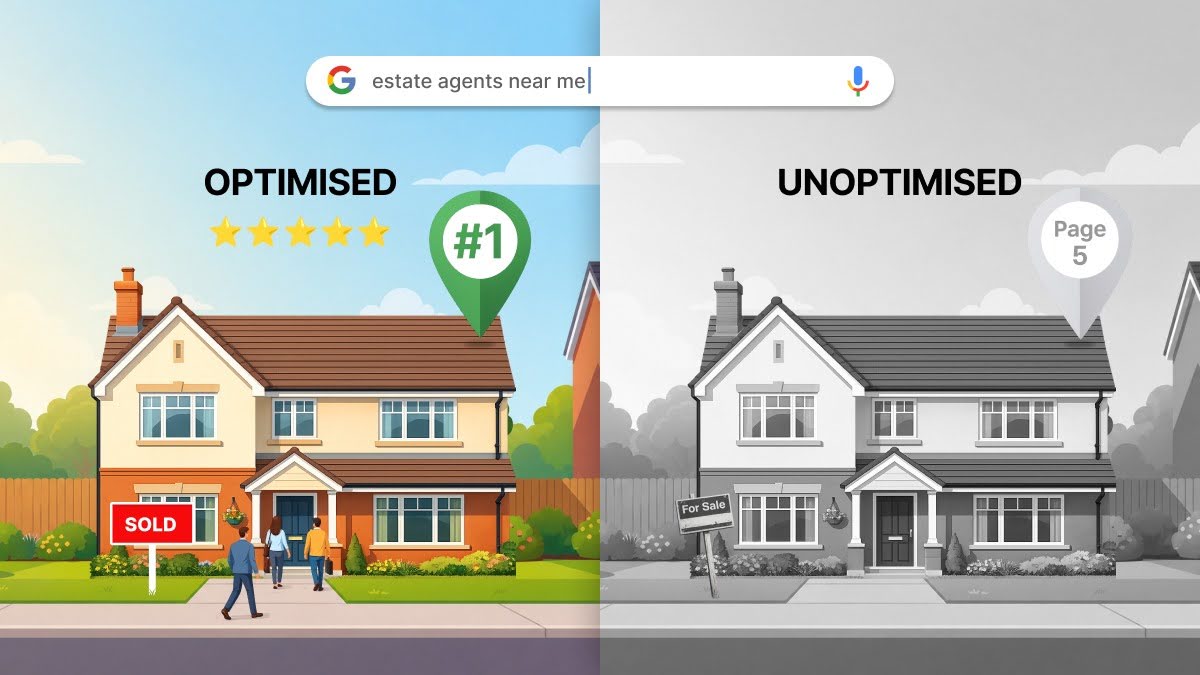
Through all of that, one thing has not changed: most of the agents who win instructions in their area are the ones who turn up first when a homeowner reaches for their phone and searches. That is what search engine optimisation (SEO) is for. And done properly, it is still one of the most cost-effective ways to grow an independent agency.
This guide is a deep dive to how we approach SEO for estate agents at Superb Digital — pulled from over a decade of doing this.
How estate agency SEO actually works
Before we get into tactics, it helps to understand what Google is actually trying to do when someone searches for an estate agent.
If a search suggests local intent — and almost every property-related search does — Google’s algorithm prioritises results that are physically close to the searcher. This is what we call local search, and it is a slightly different game from traditional, nationwide SEO. Rather than listing national brands with the deepest pockets, Google uses location data, business listings and relevance signals to serve up a localised set of results, usually with a map and three featured businesses near the top — the “map pack”.
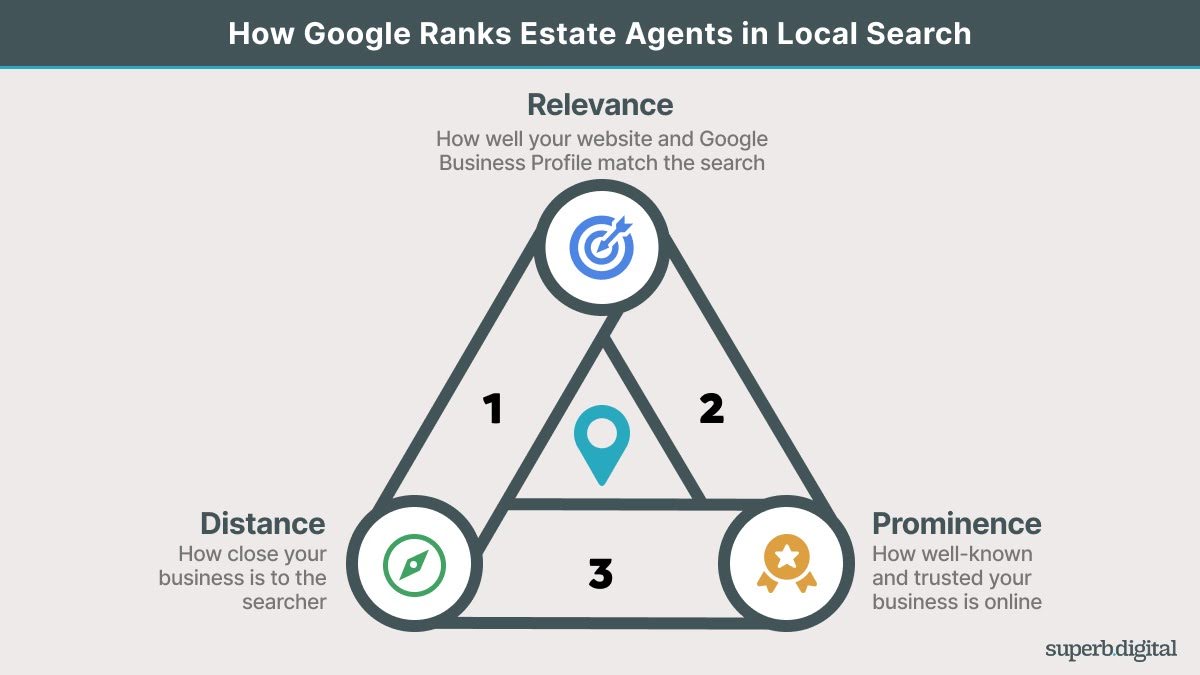
When deciding who ranks in those local results, Google looks at three things:
- Relevance — how well your website and Google Business Profile match what the searcher is actually looking for.
- Distance — how close you are to the person searching, or to the location they have specified.
- Prominence — how well-known and trusted your business is online, based on reviews, citations, links and brand recognition.
You cannot do much about distance. A homeowner in Clifton, Bristol is going to be physically nearer to a Clifton agent than a Bedminster one, and that is fine. But relevance and prominence are entirely within your control, and that is where SEO earns its money.
This matters hugely for estate agents because if your agency is not surfacing in local search results, you are not even in the running — no matter how good your service is or how slick your website looks.
The good news is that the bar in most local markets is genuinely low. Plenty of agents are still treating their website as a brochure rather than a lead engine.
Keyword strategy: searching like a seller or landlord
Every effective SEO strategy starts with understanding the language your potential clients actually use when they search. This is not about guessing — it is about putting yourself in the head of a vendor who has just had a kitchen extension finished and is thinking, “Right, who should I get round to value the place?”
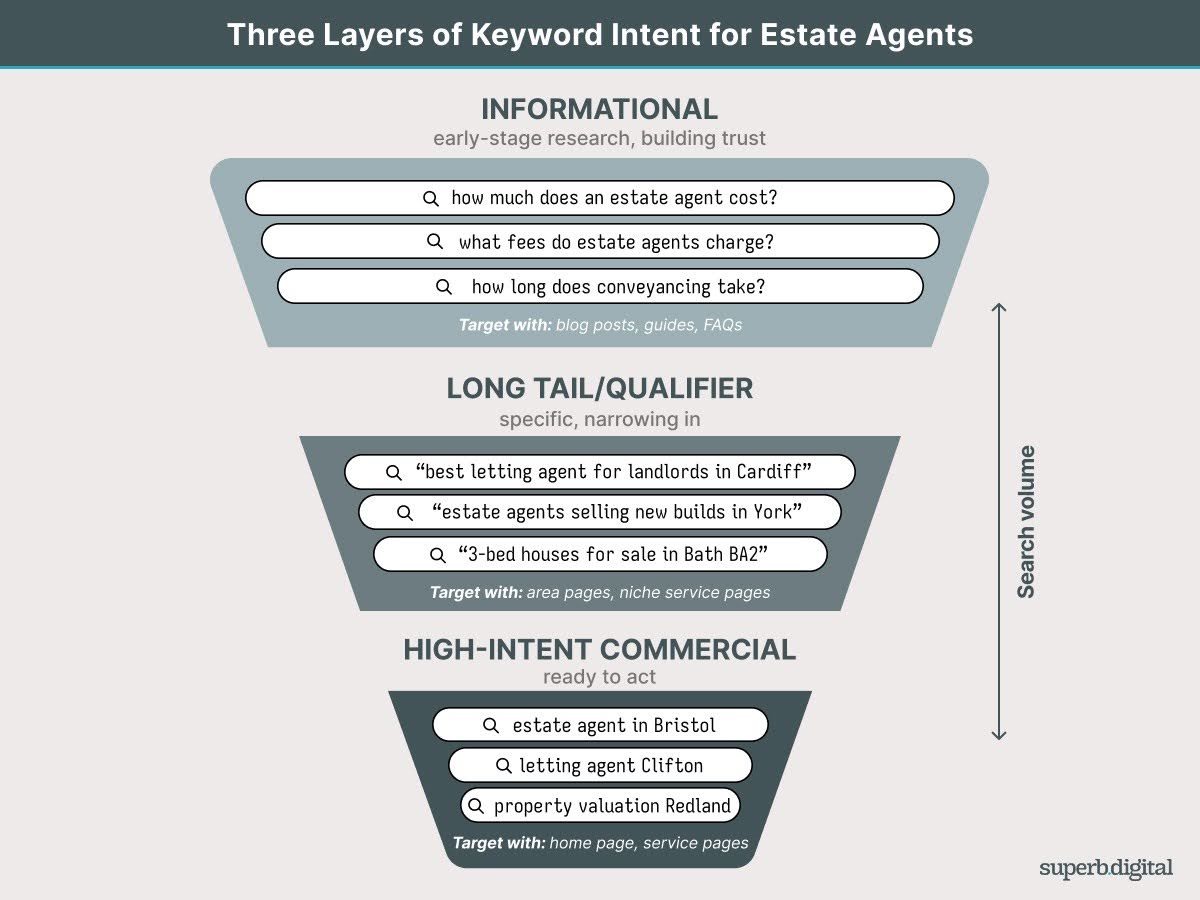
Keyword research is the discipline of mapping out those searches, then deciding which ones are worth competing for. We tend to think about three broad categories of search:
High-intent commercial terms
These are the searches where someone is close to picking up the phone. “Estate agent in Bristol”, “letting agent Clifton”, “property valuation Redland”. These should be the focus of your home page and your branch or area pages — your “money pages”, in old-school SEO parlance.
Long-tail and qualifier terms
These are more specific and lower in volume, but the intent is often higher. “Best letting agent for landlords in Cardiff”, “estate agents that sell new builds in York”, “3-bedroom houses for sale in Bath BA2”. They tend to be easier to rank for and they convert well because the searcher has already done the thinking.
Informational and research terms
These are people earlier in the journey, looking for guidance rather than a quote. “How much does an estate agent cost”, “what fees do estate agents charge”, “how long does conveyancing take”. You will not always convert these searches directly, but if you are the agent who shows up with a clear, useful answer, you build trust early — and you stay in mind when they are ready to instruct.
This last category is where many agents get search intent wrong. They try to optimise their home page or their valuations page for informational queries, and then wonder why the traffic does not turn into instructions. It will not, because the people searching are not ready to instruct yet. The fix is to build separate content — blogs, guides, area updates — for the informational layer, and keep your service and area pages tightly focused on commercial intent. Search intent is the dimension that most underpins SEO and it is worth understanding properly if you want your strategy to do more than chase rankings.
In practice, the keyword research process is straightforward in principle but takes some care to do well. You start with the obvious seed terms (estate agent, letting agent, property valuation), expand them with location modifiers for every area you cover, layer in service variations (sales, lettings, management, valuations), and then use tools like Ahrefs or Google’s own data to check what people are actually searching for and how competitive each term is. If that sounds like a job, it is — and it is the core of what our keyword research work delivers for clients.
On-page SEO for estate agency websites
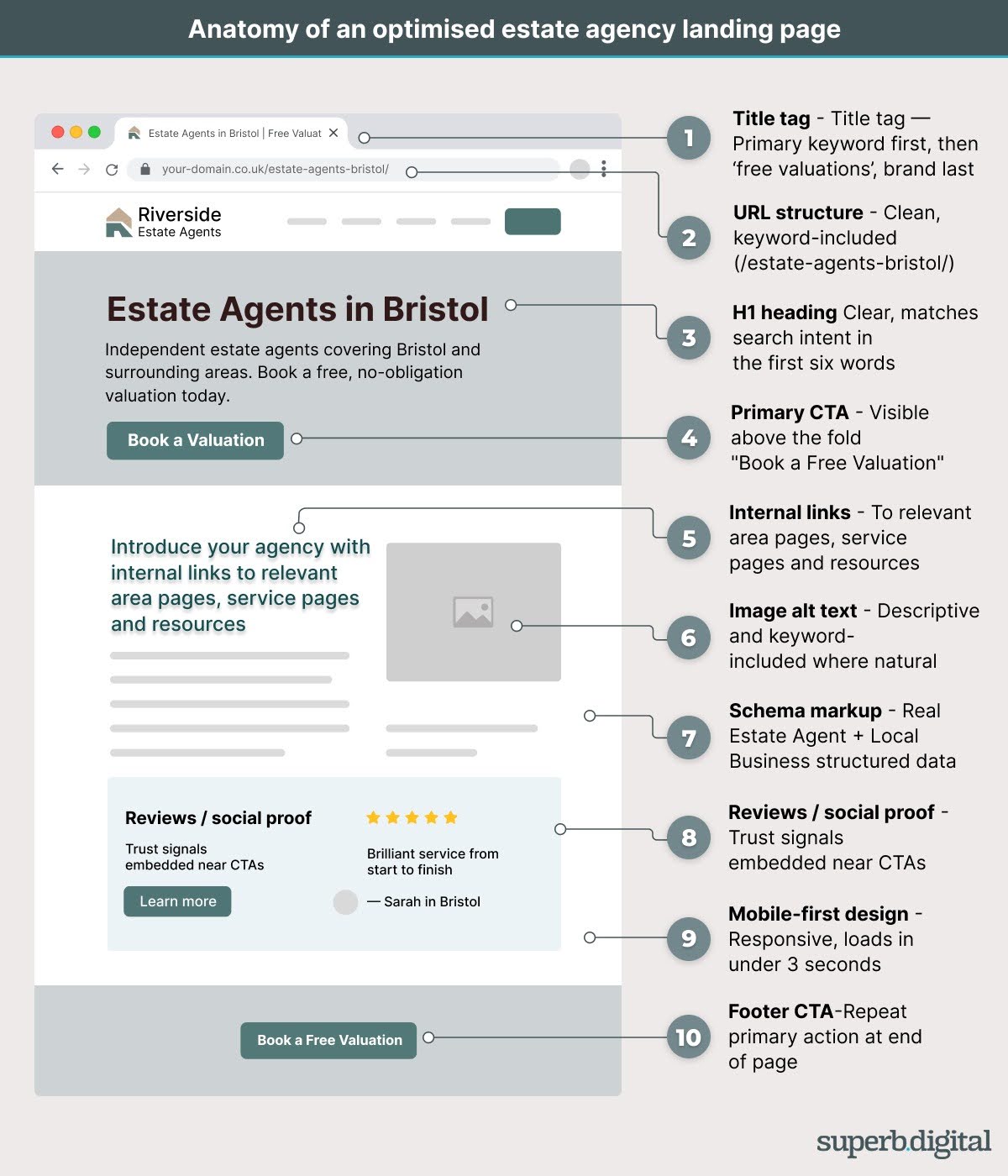
Once you know what people are searching for, the next step is making sure your website actually answers those searches when they land on it. This is on-page SEO, and for estate agents it boils down to a handful of things done consistently.
Every important page on your site should have a clear, descriptive title tag that includes the primary keyword for that page. So your Bristol sales page might be titled “Estate Agents in Bristol | Free Valuations & Local Experts | [Your Agency]”. The meta description below it does not directly affect rankings but it absolutely affects whether anyone clicks, so write it like a proper invitation rather than a string of keywords.
H1 headings
These should match the search intent of the page. Resist the urge to be clever here — if the page is about lettings in Headingley, the H1 should make that crystal clear, ideally within the first six or seven words.
Internal linking
Internal links are one of the most overlooked weapons in on-page SEO. Every time you link from one page on your site to another with relevant anchor text, you are telling Google two things: which pages are important, and what they are about. A well-linked Clifton page that is referenced from your home page, your sales page, your lettings page and a handful of blog posts will outperform an orphaned page every time, even if the orphaned page has more words on it.
Speed and mobile experience
This falls under on-page in practical terms. More than seventy per cent of property searches happen on mobile devices now, and a slow, clunky page is enough to send a prospect to your competitor’s site before they have even seen your phone number. Compress your images, keep plugins to a minimum if you are on WordPress, and invest in decent hosting. Google’s own PageSpeed Insights will tell you where the wins are.
Calls to action
Finally, every service page and area page should have a clear, single primary call to action — book a free valuation, request a market appraisal, get a lettings quote — and that CTA should be obvious above the fold and again near the bottom of the page. We see this missed regularly, and it is one of the simplest fixes for an agency website that is getting traffic but not enquiries.
Our on-page SEO work goes much deeper into the technical and editorial side of all of this.
Optimising property listings
Property listings sit somewhere between marketing copy and search-engine fodder, and most agents treat them as one or the other. The best agents treat them as both.
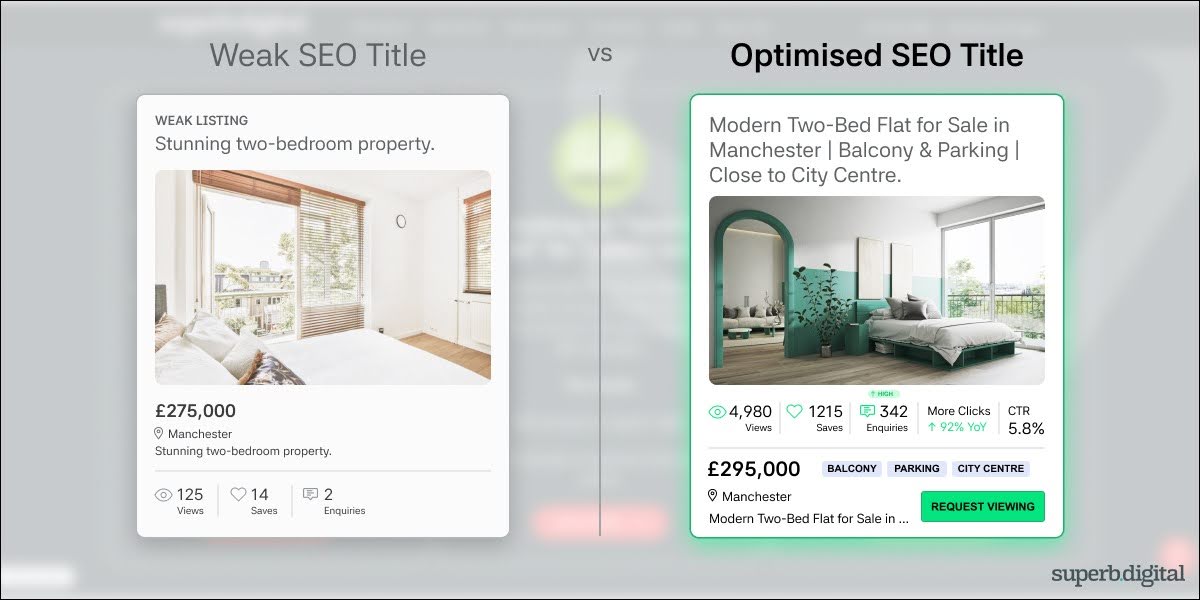
The listing title is the single most important element. Get it right and a buyer scanning ten listings will stop on yours. Get it wrong and Google will not surface it for the searches that matter. A weak title looks like this:
Stunning two-bedroom property
A strong one looks like this:
Modern Two-Bed Flat for Sale in Manchester | Balcony & Parking | Close to City Centre
The second one is doing three jobs at once: it includes the primary search terms a buyer would actually type (“two-bed flat for sale in Manchester”), it leads with the things that influence the click (“balcony & parking”), and it is structured so a tired commuter on the train home can absorb it at a glance.
Property descriptions should follow a logical structure: a concise opening that names the property type, location and standout features; a scannable bullet list of key features; an additional paragraph or two on layout and finish; and a closing section on the neighbourhood and lifestyle. Bury that structure in your house style and your agents will write better listings without even thinking about it.
A small but consistent SEO win sits in your images. Filenames like IMG_2347.jpg tell Google nothing. Filenames like two-bedroom-flat-manchester-deansgate.jpg, paired with descriptive alt text, give the search engine context it cannot get any other way. The same goes for videos — embedded YouTube walk-throughs tend to do double duty, ranking on YouTube as well as feeding into the property page itself.
One more thing: search engines favour fresh content. If a listing sits unchanged for months, it will drift down the rankings. Small refreshes — a new lead image, a tweaked description, a new feature highlight — signal that the page is still active.
I explore all of this and more in our guide to optimising property listings for search engines, if you want a deeper dive into this subject.
Local SEO: dominating your patch
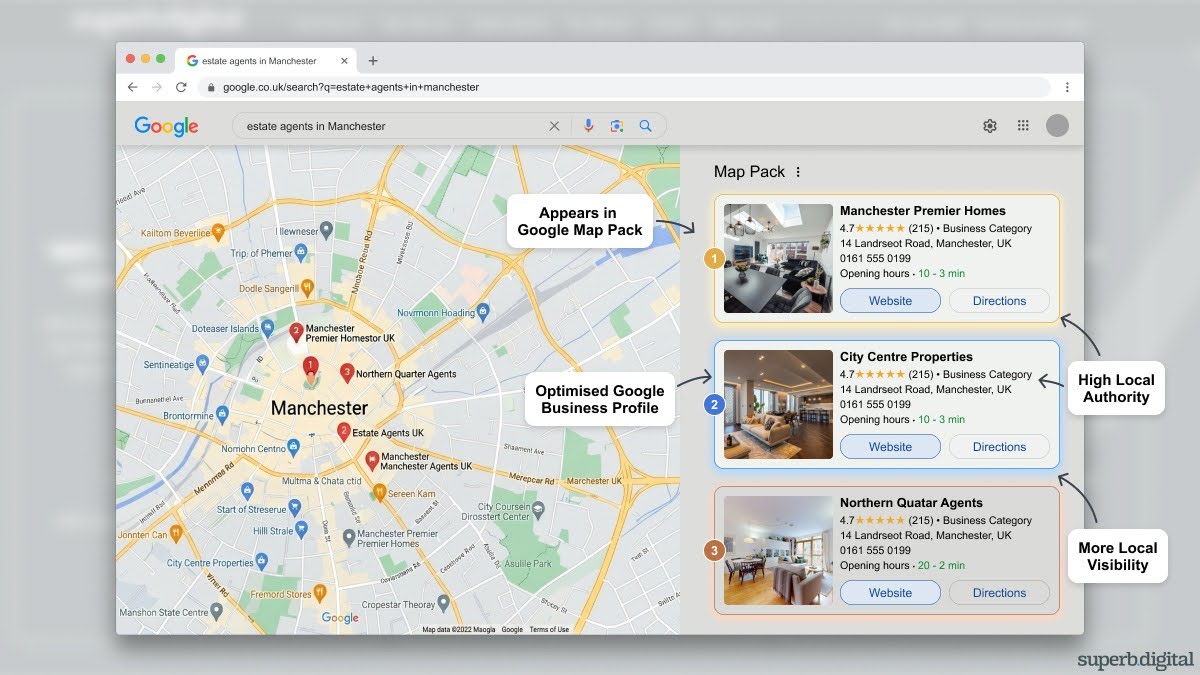
If there is one section in this guide to read twice, it is this one. Local SEO is where independent estate agents win or lose. The agencies we work with that get this right do not just appear in the map pack for their primary town or city — they show up across a cluster of surrounding villages and postcodes, and they get there without spending a fortune on Rightmove featured agent slots.
There are four pieces to this section: your Google Business Profile, your NAP consistency, your local citations, and your reviews. Get all four right and you have built a moat around your local market.
Google Business Profile
Your Google Business Profile (formerly Google My Business) is the most important free marketing asset you have. It is what Google leans on to populate the map pack, and it is increasingly what feeds AI Overviews and other AI-driven local results. Treat it accordingly.
Claim and verify the profile, then fill in every field — primary and secondary categories, opening hours, service areas, attributes, the lot. Add high-quality photos of your office, your team and recent properties. Refresh them every few months so the profile does not look stale. Use Google Posts to share new instructions, market updates and local content; they appear on your profile and feed your prominence signals over time.
There is a dedicated walk-through of all of this in our Google Business Profile optimisation guide for estate agents, which I recommend bookmarking.
If you operate more than one branch, give each office its own verified Google Business Profile, with its own address, phone number and photos. A single profile will not rank you in the map pack for an area where you have a separate office.
Reviews
Reviews carry serious weight. Both quantity and rating matter, and Google’s algorithm increasingly factors in review recency and the substance of what reviewers actually say. An agency with thirty reviews from the last twelve months will out-perform one with ninety from five years ago.
The practical advice is simple: after every completed sale, let or appraisal, ask. Use a short URL or QR code on your follow-up emails so it takes ten seconds rather than ten minutes. Respond to every review you receive — positive or negative, ideally within a day. And do not be tempted to incentivise reviews with discounts or freebies; it breaches Google’s guidelines and will catch up with you sooner or later.
Google Q&A
Sitting just below the map listing on your Google Business Profile is a small Q&A section that most agents do not even know exists. People can ask questions — “do you offer evening valuations?”, “do you charge a withdrawal fee?” — and anyone can answer them, including you.
This is a small change that can make a disproportionate difference. The content is indexed, which means it feeds your local SEO. The questions and answers help reduce the friction between someone discovering you and picking up the phone. And critically, you can ask and answer your own questions from a personal Google account — meaning you get to control the conversation before it starts.
Try adding three to five FAQs to your profile this week. Pull them from the things you get asked on the phone every day: weekend appointments, parking, fees, areas covered, how quickly you can value a property. Keep your tone simple and friendly. Check the section weekly to catch any unhelpful answers other users may have posted.
NAP consistency and local citations
Your name, address and phone number — NAP, in industry shorthand — is the backbone of your local SEO. Google uses it to verify that your business is real, located where you say it is, and consistently represented across the web. Every directory listing, every social profile, every place your details appear is what we call a citation.
The trick is consistency. “Smith & Co Estate Agents, 12 High Street, Bristol BS1” needs to appear exactly the same way everywhere. Not “Smith and Co”. Not “12 High St”. The smallest discrepancies dilute the signal.
Prioritise building citations on the directories and platforms that matter for UK estate agents:
- Google Business Profile (the most important by miles)
- Bing Places
- Apple Maps
- Yell, Thomson Local, Scoot, FreeIndex, 192.com
- Your local Chamber of Commerce
- Property-specific platforms — Rightmove, Zoopla, OnTheMarket, where you list properties
- Industry directories such as Propertymark, Kerfuffle or local trade bodies
It is worth keeping a single master NAP document somewhere, listing your exact name, address and phone number format, so anyone in your team submitting a new listing has a reference. Audit your existing citations every six months using a tool like BrightLocal — or by doing a manual sweep — to clean up duplicates or outdated entries. Small discrepancies are easy to fix when caught early and surprisingly damaging if left alone.
Multi-location agencies and area pages
For agencies with more than one branch, or that cover multiple distinct areas from a single office, the temptation is to create one page that says “we cover Bristol, Bath, Weston-super-Mare and Portishead” and call it a day. Do not do this. Each area you genuinely cover deserves its own page, and each of those pages needs to be substantively different from the others.
What does “substantively different” look like? It means real local commentary — the type of properties that tend to sell in that area, the catchments parents care about, the transport links, the recent market shifts you have observed. AI tools and Google are increasingly good at spotting templated pages where only the place name has changed, and they will demote them ruthlessly.
If you do this well — distinct area pages with genuine local knowledge, each linked to the right map pack and supported by reviews from clients in that area — you can dominate local search across a cluster of postcodes from a single office. It is one of the highest-leverage things an independent agency can do.
Content strategy: area guides, market updates, FAQs
For most estate agents, content is the gap between turning up on Google and being chosen. It is what builds authority over time, attracts traffic for the long tail of informational searches, and increasingly, what feeds AI summarisation when someone asks ChatGPT or Google’s AI Overview which agents are worth speaking to.
The mistake I see most often is agencies trying to publish “content” in the abstract — generic posts about how to dress a property for sale, that any agent in the country could have written, with no real local insight. That is not thought leadership; that is filler. And it does very little for your SEO.
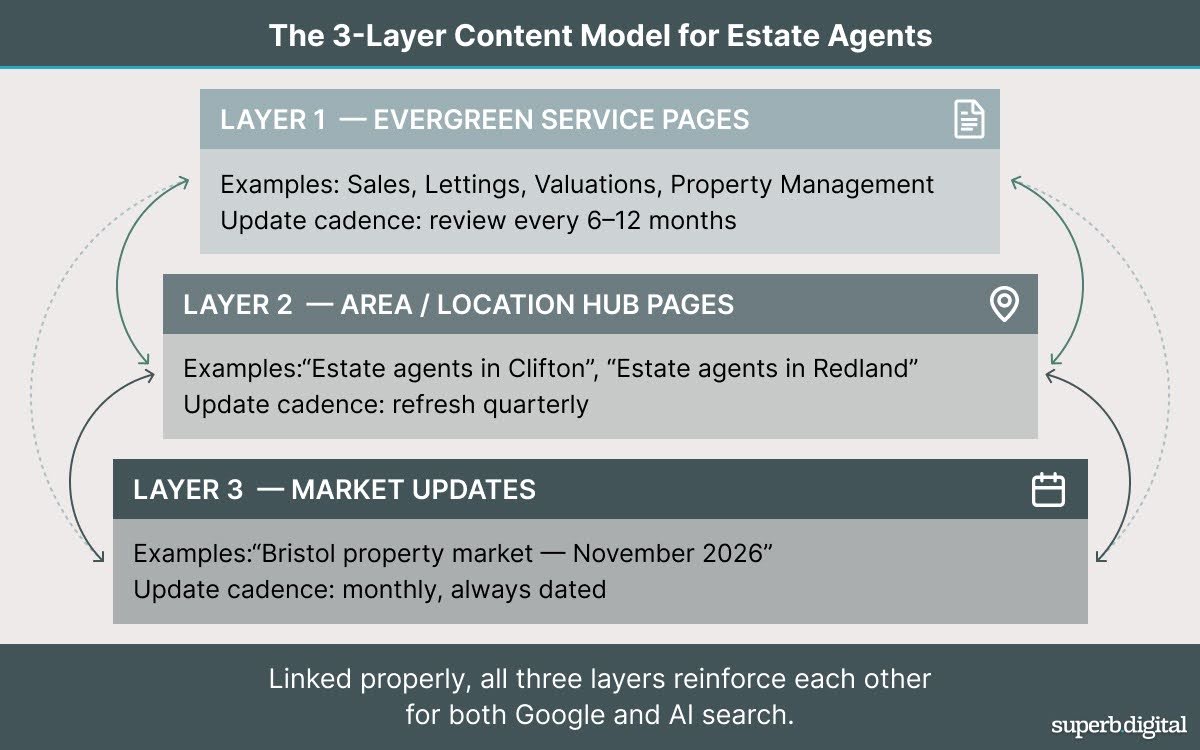
A simpler, more effective model is to think about three layers of content, each doing a specific job:
Evergreen service pages
Sales, lettings, valuations, property management. These pages should explain your process clearly for someone who has never moved house before, break down fees transparently, set expectations on timelines, and address common objections head-on. Review them every six to twelve months, or whenever something changes.
Area or location hub pages
One page per area you genuinely serve. Cover the housing stock, the buyer demographics, the schools and catchments, transport links, parks and green spaces, and your view on what is happening in the local market. Update them quarterly with fresh highlights and link them to your latest market updates.
Market updates
Monthly, dated snapshots of what is happening in your market. “Bristol property market — November 2026”, with local pricing data, mortgage context, demand shifts and a paragraph of expert commentary on what is actually happening on the ground. These do a lot of work: they feed the search appetite for fresh, local data; they signal active expertise to AI summarisation tools; and they give your agents something genuinely useful to share with prospects.
Tie the three layers together with internal links — service pages reference area hubs, area hubs reference recent market updates, market updates link back to relevant services — and you have a content engine that grows in value over time, rather than a back catalogue of dusty blog posts. This is the heart of what our ongoing content creation and optimisation work delivers for our clients.
Technical SEO essentials
Technical SEO is the plumbing. You do not need to be an expert to make sure it is in good order, but you do need to make sure nothing is leaking.
The non-negotiables are page speed (loading in under three seconds, on mobile, every time), a mobile-first design that works properly on a phone rather than just a shrunk-down desktop view, HTTPS across the whole site, and a clean URL structure that makes intuitive sense to both users and search engines.
Schema markup is the technical layer where most estate agents are leaving value on the table. Schema is structured data that tells search engines exactly what your page is about — that this page describes an estate agency in a specific city, that this listing is a property with a price and bedroom count, that these reviews carry a four-and-a-half-star average. With the right schema applied to listings and service pages, your results in Google can include rich snippets — extra detail, star ratings, prices — that lift click-through rates noticeably. The two relevant schemas to apply are RealEstateAgent and LocalBusiness, with FAQPage and HowTo schema on relevant content pages.
Crawlability rounds out the picture. Make sure your sitemap is up to date and submitted to Google Search Console. Avoid hiding important content inside PDFs or JavaScript that search engines (and AI tools) struggle to read. Check your robots.txt is not accidentally blocking the pages you want indexed — we have seen agencies invisible on Google for months because of one badly placed line. Our technical optimisation service is built around fixing exactly these kinds of issues.
Building local authority and links
Backlinks — other websites linking to yours — remain one of the strongest signals Google uses to judge prominence. For estate agents, the goal is not to chase backlinks in the abstract but to build genuine local authority.
The most reliable sources for an estate agency are the ones already in your orbit. The local builders, solicitors, surveyors, mortgage brokers and removal firms you work with every week are all candidates for a partner page, a recommended-suppliers list, or a “businesses we trust” section on each other’s sites. List them out, find a page on their site where a link to you fits organically, and ask. The yes rate is high.
Local press is the second avenue worth investing in. Local papers and community magazines are always short of stories, especially ones with a hyper-local angle. An anniversary, a new branch opening, a sponsored junior football team, a charity drive, a piece of market commentary tied to a national story — all of these are easier to place than you think. Each placement is typically a high-quality backlink from a domain Google trusts, plus the brand-building benefit on top.
Citations, which we covered above, are not technically backlinks but they often come with them, especially from your Chamber of Commerce, industry trade bodies and the better-quality regional directories. Build them properly and you are accumulating local authority in the background.
What to avoid: low-quality paid link schemes, link exchanges with unrelated international sites, and anything offered by an SEO firm cold-emailing you to “guarantee” a number of links per month. These can do real damage. If a link is not something you would be happy to mention by name to a client, do not pay for it.
AI search and what’s changing
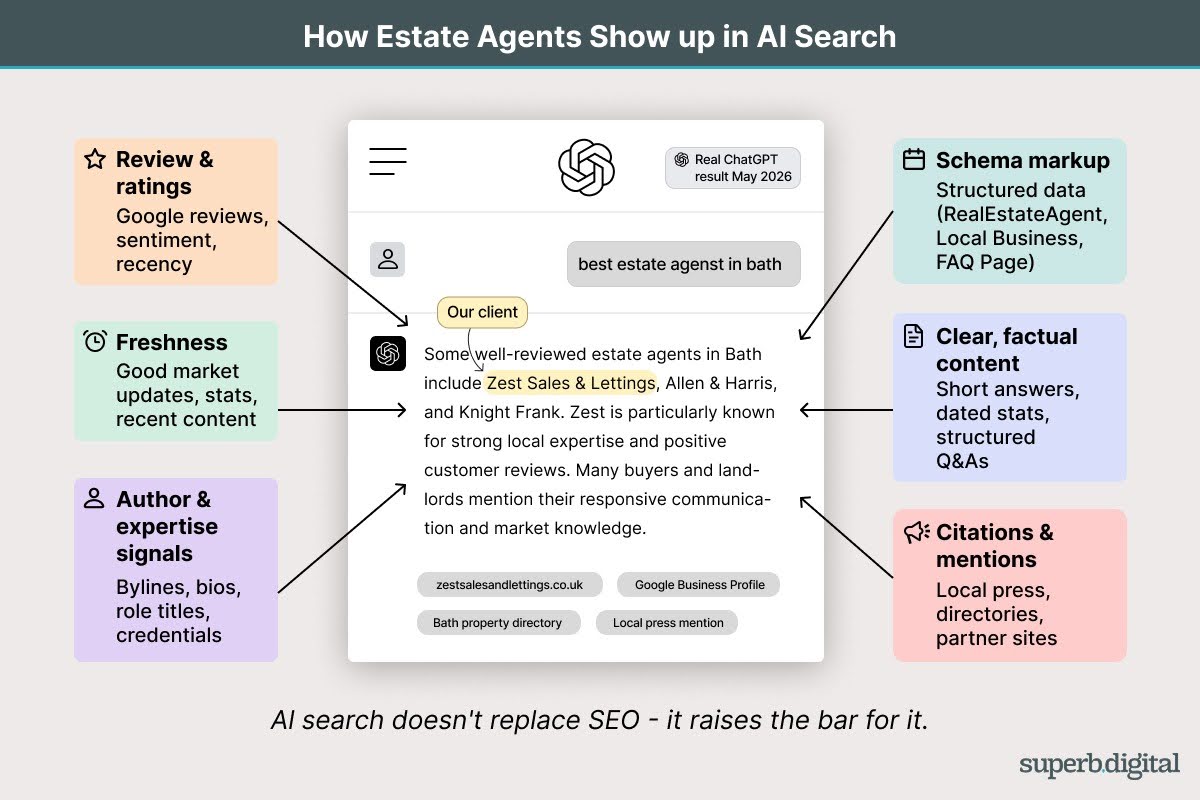
The biggest shift in search since Google launched is happening right now. Tools like Google’s AI Overviews, Bing Copilot and ChatGPT are answering more and more queries directly, summarising information from across the web into a single response — often without the searcher ever clicking a link.
For estate agents, this changes what visibility means. Ranking in the top three organic results is still important, but it now sits alongside something newer: being the source that AI tools cite, summarise or recommend when someone asks “who is the best estate agent in [area]” or “how much does it cost to sell a house in [area]”.
The good news is that the fundamentals still matter — local SEO, clear content, structured data, reviews and authority all feed into what AI surfaces. The shift is in how content needs to be written and structured.
Three practical changes are worth making:
Write to be summarised: AI tools prefer content that is clear, factual and easy to extract. Short answers to specific questions, dated statistics, structured Q&A blocks and unambiguous explanations of fees and timelines all do well. Vague, padded prose does not.
Add schema and structured data: Use RealEstateAgent, LocalBusiness, FAQPage and HowTo schema across your key pages. It helps both Google and the AI tools parse your content properly.
Become a credible local source: Bylines, author bios, role titles, dated market updates with original commentary, links from local press — all of these strengthen the signals AI uses to decide which sources to trust. Generic, undated, anonymous content gets bypassed.
AI is something that is hugely on our radar and I have written a dedicated piece on what AI means for estate agency SEO if you want to go deeper on this — including the 3-layer content model that pairs particularly well with AI-driven search.
For most agencies, the practical takeaway is the same: AI is not replacing SEO so much as raising the bar for it. The agencies producing genuinely useful, well-structured, locally specific content will benefit. The ones publishing templated filler will quietly disappear.
If you want a understand where your own agency stands in AI Search then I highly recommend joining the hundreds of other agents who already have by taking our AI Search Quiz. It takes about five minutes and you’ll get scored across three areas and receive a free report in your inbox.
Measuring success: tracking what matters
SEO is not a one-and-done job. It is a long game, and the agencies that succeed are the ones that keep an eye on the right numbers month to month.
The four metrics worth tracking properly:
Organic search traffic
Google Analytics tells you how many people are arriving via organic search, which pages they land on, and how long they stay. A rising trend over a quarter or two is the simplest sign things are working.
Keyword rankings
Track your top twenty or thirty target terms — both the broad commercial ones and the area-specific long-tail. You are not looking for daily movement, but you do want to see a steady climb. If you are sitting on page two for high-value terms, that is a signal that a small improvement to the page or its internal linking could push you onto page one.
Google Business Profile activity
Inside your profile, you can see how many people viewed your listing, clicked through to your site, requested directions or called you directly. These numbers are a much better proxy for real-world interest than abstract impressions.
Enquiries and instructions
The numbers that actually matter. Set up call tracking, form tracking and valuation request tracking inside Google Analytics so you can see which channels and which pages are producing real business. If your traffic is up but your enquiries are flat, something on the site is broken — and it is usually a CTA, a form, or a page that does not match the search intent it is ranking for.
Resist the temptation to obsess over rankings in isolation. Plenty of agencies sit at number one for a low-volume vanity term and wonder why nothing converts. The point of SEO is enquiries, valuations and instructions — and that is the lens to measure it through.
How Superb Digital can help

Most of what is in this guide can be done by an in-house team that is prepared to invest the time. But “invest the time” is doing a lot of work in that sentence. SEO done properly is a continuous discipline, not a project, and it is rarely the highest-value use of an estate agent’s own hours.
If you would rather hand it off to people who have done this for independent UK estate agents for over a decade, that is what we do.
We work with agencies of all sizes, from single-branch independents to multi-location regional networks. Our results across our estate-agent client base include 250%+ increases in enquiries, halved PPC costs, and millions in new revenue generated through smarter web design and direct lead capture.
If any of that sounds useful, you can book a discovery call and we can talk through where your agency stands today and what the realistic upside looks like.
Or, if you want to explore what we offer first, check out our SEO service for estate agents page, which has all the details.
Either way — good luck. The agencies that take SEO seriously over the next two to three years are the ones that will keep growing while everyone else is still arguing about Rightmove fees.

Posted by
Paul Morris
01 June 2026
 Estate Agents